“Anti-War Forces Reject Arab League’s Welcome for Sudan Dialogue Initiative, Call for Immediate Ceasefire”
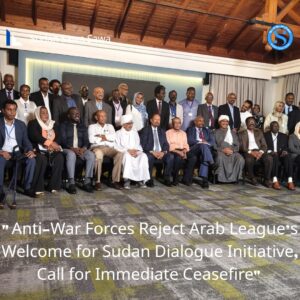 While fully convinced that there is no way to end the war in Sudan except through serious dialogue, the anti-war forces reject a statement issued in the name of Arab League Secretary-General Nabil Fahmy welcoming what has been described as an initiative by a group of prominent Sudanese figures to pave the way for a Sudanese-Sudanese dialogue.
The anti-war forces argue that ending the war is neither a priority nor an objective of the initiative. In response to the statement, they wish to clarify the following:
First, the anti-war forces unanimously affirmed in their document issued in Addis Ababa last August that they do not believe there is a military solution to the national crisis. Through their various components, they have consistently called for a peaceful political solution based on dialogue and negotiations.
They say it is unfortunate that the Arab League has not responded adequately to what they describe as the world’s largest humanitarian catastrophe caused by the war that began on April 15. They also question the League’s decision to welcome an initiative they describe as flawed in its concept, design, and source, particularly because its originator is a party to the conflict.
According to the anti-war forces, the initiative in its current form poses a genuine risk because it could legitimize the war and the deteriorating political reality it has created, including the institutionalization of division, which threatens the unity of Sudan. Instead, they argue that the Arab League’s principled position should be to call first and foremost for an unconditional cessation of hostilities.
Second, the anti-war forces say they have repeatedly warned that the proliferation of peace initiatives has become one of the tested mechanisms contributing to the prolongation of the war.
They question the value of the Arab League welcoming another initiative that could waste time and resources and open up further political debate over an idea that may appear positive on the surface, while millions of people are going hungry, women and children are being killed, and the conflict continues to spread.
They argue that it would be more appropriate for the Arab League to issue a clear and direct call to the parties to the conflict to immediately and unconditionally stop the fighting, first to allow humanitarian assistance to reach those in need, and then to prepare for an inclusive dialogue through which Sudanese people could determine the most effective way to launch a comprehensive peace process.
Third, the anti-war forces renewed their call on the members of the Quintet, as well as all neighboring and regional countries, to work toward persuading the Sudanese Armed Forces and the Rapid Support Forces to immediately and unconditionally end the war and come to the negotiating table in accordance with the Quad’s roadmap, which has established a clear conceptual and time-bound framework.
They said this would be preferable to relying on developments on the battlefield to alter the political balance.
The anti-war forces stressed that the reality of the April 15 war has gone beyond what is happening on the battlefield and has become a threat to Sudan’s social fabric and to the very idea of the nation. They warned that changes on the ground could pave the way for an endless war before it evolves into a war of revenge or becomes an end in itself, driven by the political economy that the conflict has created.
“Stopping the war today, not tomorrow,” they said is what Sudanese people are calling for and what they deeply aspire to.
In conclusion, the anti-war forces reiterated their rejection of the war and of the notion that there is a military solution to Sudan’s national crisis. They renewed their call on the Sudanese Armed Forces and the Rapid Support Forces to accept the proposed unconditional humanitarian truce without delay or obstruction as an entry point for addressing the humanitarian crisis and creating an environment conducive to a comprehensive peace process that ends the war and lays the foundation for a civilian democratic transition.
They also called on all Sudanese to reject the war, refrain from engaging in its rhetoric and daily realities, and come together to end what they described as a tragedy that, after destroying the country’s agriculture and livestock, is now destroying its social institutions.